Wednesday, August 7th: Another two day blog post with lots of photos. Yesterday, we traveled by FlixBus from La Rochelle, France to Donostia San Sebastián, Spain. It was a long, 7-hour ride on the bus, not quite as smooth as the bus ride two days prior. Betsy and I listened to part of an audio mystery book - Killers of a Certain Age, by Deanna Raybourn (four retired women assassins who are fighting back against their employers after a 40-year career - low on plausibility). We arrived in San Sebastián in time for dinner. The city was hopping and full of tourists, mostly French and Spanish. The city is in Basque country and signage for the city uses four languages -- Basque, Spanish, French, and English.
Our first impression - San Sebastian is quite grand - many buildings imitate Parisian architecture. Our hotel was set in a newer part of the city, one block inland from a big bay and La Concha beach.
Nice cobblestone streets and few if any cars.
Our dining spot - a typical pintxos bar (akin to tapas). We stood at the counter and had various cheese omelette sandwiches - very reasonably priced. The beer was 2.5 euros (or about $3) for a pint. The ambience is loud and lively.
We strolled through more of the Old Town after dinner and came across a free organ concert being held in one of the churches. We listened to several pieces and marveled at the organist's feet movement. Since organists play out of sight, the organizers set up a video stream. The video screen was split and switched between views of the organist's feet dancing over the foot pedals, hands moving around the multiple keyboards, and the musician himself.
The 'feet video' is in the upper left of the screen.
A dramatically lighted baroque church on our way back to our hotel. Later we found out from our walking tour guide that this was church for the "rich people."
The beach and inner bay.
Ditto.
Urgull Head with a statue of Christ on top in what was historically a castle that protected the city.
Swimming at 10 pm.
The same view as last night but taken this morning -- our destination was the top of the hill.
The gang is off to conquer the hill. There is an impressive promenade along the beach which is the main thoroughfare for tourists. Below the promenade is a covered arcade with access to changing rooms, showers, and snack bars on one side and the beach on the other - very nice infrastructure.
Amazing sand art. The bay has huge tides - at high tide this area will be completely underwater.
Made by a different kind of busker.
He is using a garden rake, and his helper smoothed out the edges.
The viewers are encouraged to toss down coins and try to hit a blanket.
Leslie, Jan, and Dennis with Ron behind Dennis on the promenade. The clouds kept the temperature cool and comfortable all day.
View of the beach (la Concha) and newer parts of the city partway up the Urgull Hill.
Nearing the top of Urgull.
Looking across as the mouth of the bay to Isla de Santa Clara and Mount Igueldo.
Sailing class.
View from on top.
Ditto.
The edge of Old Town.
San Sebastián was an important ship building area.
A model of the city in 1813 - it was a walled city on the back side of Urgull. Being on the border between France and Spain and possessing many natural resources, San Sebastián was frequently under attack or domination. Walls and forts were built to keep enemies out, but also contained the city's growth to the Old Town area. When the Spanish government finally gave permission for the city to be "demilitarized" in the 1860s, the walls were immediately demolished and the community spread out over the surrounding hills. Much of the new construction was intended to attract the new wave of tourists and vacationers.
The statue of Christ on top of Urgull.
Panorama of the city.
The other side of the city looking the commercial port entrance and another beach with higher waves.
This is the church where we heard the organ concert. Again, we learned that this was the church for the "poor people."
This is some regular sized 'riprap.' Note the size of the blocks compared to the people on the sidewalk.
The blocks are about 8 feet or more on each side.
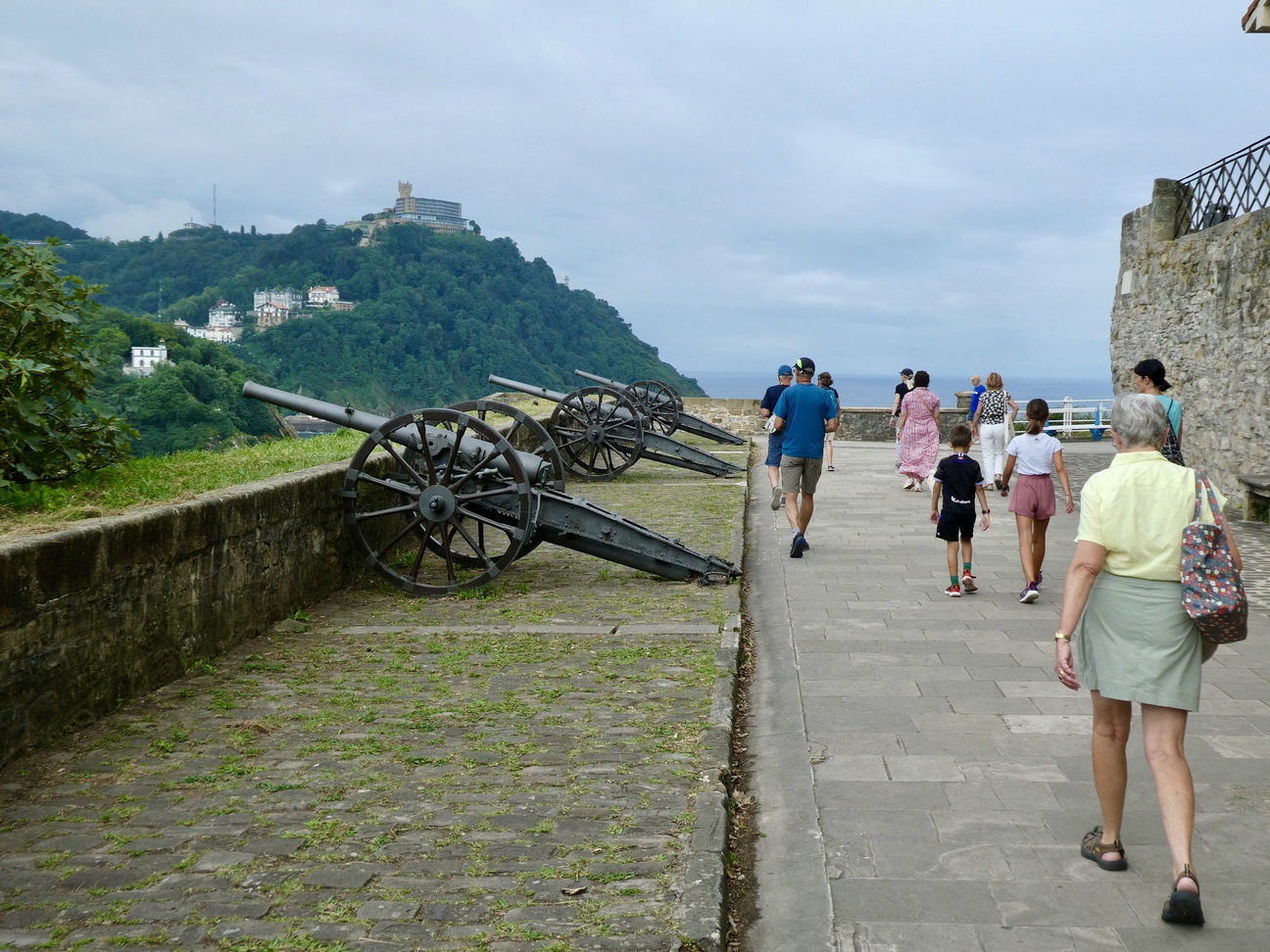
A gate to the castle.
A gate to the old city.
After a break back at the hotel, the gang met up to take another "free" English walking tour between 4 and 6 pm. We got to the meeting site early, found our guide Pete, and waited for the remaining 8 folks who were also going on the tour. We walked around the old city and central city, stopping at about 10 to 12 places. Pete gave us a good overview of the Basque culture and history, with a little Spanish influence, provided tips on how to order pintxos (tapas-like small plates) and what to do and not do in bars, and answered questions very willingly. The city has two names - Donostia (Basque name - place where saint was buried) and San Sebastián (Spanish name of patron saint).
Main town square, used for bull fighting historically and for the many festivals held in the city. City Hall is on the left, apartments on the right with very visible numbers (rented out during festivals).
A grand hotel in the newer City Center which has bullet holes from the Spanish Civil War.
Ditto.
After the tour, we went to Bodega Donostiarra Gros for dinner -- a place that Pete recommended. It is on the other side of the river (less hectic area of the city). we enjoyed a selection of pintxos. We then walked back over the river to the main city Cathedral (Good Shepard of San Sebastián) to attend another free organ concert. The organist was Carole Williams and she played 10 selections, including a couple of modern pieces. It seemed a bit muddy to me and very loud. But her finger and feet movement was impressive to see.