Monday, August 7, 2023

Upper Midwest Tour, Day 28 - Aug 6th


A day of driving with a stop at Ulysses S. Grant's home in Galena, IL and another successful summit of a State Highpoint -- Charles Mound, IL.

To finish up yesterday, after a dinner of pizza and salad, we walked to the Springfield Train Station.  It is here that Lincoln left for a whirlwind trip to DC after being elected to the Presidency.  He gave an elegant 'thank you' and farewell speech from the back of the train, which is classical Lincolnesque -- short, and poignant.  It is in the style of the Gettysburg address.

We left Springfield early Sunday morning (the town was quiet -- not many people out and about anytime we were there) and zoomed up the interstate.  We passed New Salem, where Lincoln lived as a young man, but did not stop -- it is closed on Sundays and Mondays.  We left the interstate at East Moline and then traveled up next to the Mississippi River.  We arrived in Galena, a once-prosperous town that was more populous than Chicago in the 1840s.  Lead mining and a port town were its claims to fame.

We stopped and toured a home that U.S. Grant was given by the rich town fathers, after the Civil War.  His family owned the house for about 8 years, but only occupied it for 1 1/2 years.  In 1868, Grant was elected as the 18th President, and moved to DC.  He lived out the rest of his life in New York, dying of throat cancer.  Our tour guide said he smoked 12 cigars a day (not unusual for military men who used he nicotine to relax and maybe cover up the horrendous odors of war.  The Galena house had two stories, with a typical layout - first floor had a parlor, dining room, sitting room and kitchen and the second floor had five bedrooms.  No running water but a copper lined tub off the kitchen.  Most of the furniture is original because the house had a single owner after the Grants who gifted the site to the state.


The house sits atop a bluff with a view down to Galena.

Parlor, the most formal of rooms.

Dining Room.

Sitting Room (otherwise known as the Family Room today).

The Bedroom.

Our next important stop was the access to the Illinois Highpoint.  It is called Charles Mound and is on private property.  In fact, the owners' house is about 100 feet from the high point.  They open access to the public (weird people like us) on the first weekend of each month; otherwise the site is not available to climb.  It is in the middle of a farming area and  is surrounded by fields of corn and soybeans and oak woodlands.  We parked on the road (as instructed by the owners through an email) and walked 1.2 miles and 200+ vertical feet to the top.  The path follows a driveway.  I have included some photos that look out toward Wisconsin.


After the highpoint, we drove a short distance to the Apple River Canyon State Park.  We had reserved a site and after setting up camp we walked around a bit.  The photo below shows the shallow Apple River and the limestone cliffs that gave the place its name.


I think we were the only campers at the campground.  We decided to drive into the town of Stockton for dinner at the Corner Tap  as recommended by the campground host.  It looked as if it was one of two places in town; the other called The Pit Stop was located at the other end of the town's main street from the Corner Tap. Our dinner was surprisingly inexpensive, but the TV screens were tuned to channels not to our liking (the choice was either FOX politics or hunting, etc.). 

We stopped in a grocery store for supplies for breakfast before returning to the campground.  The evening got very dark but was noisy -- the crickets and cicadas were rather loud, and the raccoons came by to wrestle with the trash cans and other places.  Here is the evidence they checked us out.

Note, the little paw prints on our box.

Eastern Towhee which we saw on the way up to the highpoint.

A Sharp-tailed Grouse, just off the road.  She had several chicks with her that sensibly hid in the brush.


Saturday, August 5, 2023

Upper Midwest Tour, Day 27 - Aug 5th

Sightseeing in Springfield with lots more of A. Lincoln and a few other things.  After breakfast in the motel and with cloudy skies which threatened rain all day, we ventured out on the the South loop of the Volkswalk. 

An early morning photo of the Capital building.

A monument to firefighters around the backside of the Capital grounds.

A Monarch butterfly that posed quite nicely.

Our first noteworthy stop was the Dana-Thomas House.  It is a well-preserved house designed by Frank Lloyd Wright for local socialite Sarah Lawrence Dana, built in 1904.  It was early in Wright's career and shows off a multitude of his special design elements.  Reservations were required to access a tour, but the visitor center/shop across the street said we might be able to join a tour that was booked up if there were no-shows.  We waited about a half hour by wandering around a couple of blocks to see if we could join the next tour.  It worked out - there were only 8 people in the tour group.  The tour lasted about an hour and the guide was very well-informed.

Vachel Lindsey House, seen while walking around the blocks waiting to go on the tour.  He was a well-known poet and artist, born 1879, died 1939.

The Lindsey house front door with handsome glass etching.


No photographs were allowed inside the Dana-Thomas House.  The outside had the classic look of the Prairie-style design of Wright -- large porches, generous overhangs, and "Roman" bricks (long and thin with thin mortar lines) that emphasized the horizontal lines.  The home contains one of the largest collections of site-specific, original Wright art glass and furniture, so is very special. 

The house, which is about 12,600 square feet, was intended to host parties and other social events and contains a generous dining room, a library, a performance/meeting space, 3 musicians' galleries, an organ, and a basement bowling alley.  It was the first residence in Springfield to have electricity and also had modern plumbing and heating systems.  Other appealing features included:  multiple levels, ceilings of different heights (including two large barrel-vaulted ceilings), built-in furniture (book cases, window seats, chests and cabinets), windows on 2 or 3 sides of every room allowing light and air in (even the internal rooms had glass doors), a pair of inglenooks, and a thoughtful mix of public and private spaces.  The wood was gorgeous, and the art glass windows and doors were both eye-catching and soothing with muted colors that glow in the sunlight.  As is typical for Wright, the chairs were striking but not comfortable and the rooms and overall design was fabulous.  They were reminiscent of the furniture designed by Charles Rennie Mackintosh, as seen in Scotland.


Copper frieze - but made from plaster that is plated to look like weathered copper.

Our next stop along the walk was Lincoln's Home. where the family lived between 1844 and 1861.  It is a National Historic Monument set in a four-block preserved neighborhood.  At the Visitor Center, we obtained tour tickets for the next available tour.  The tickets are free and we had about a 45 minute wait.  Ranger Nat (from Manassas, VA; first job with NPS) led about 12 people on a tour of the house.  Nat was thorough in his descriptions of the rooms.  The first floor had a parlor, dining room, sitting room and kitchen.  The second floor, which was added only a few years before Lincoln was elected president, had 3 bedrooms and one servant's room.  There was a 3 hole outhouse out back and a carriage house.  Only some of the furniture is original but everything is the right period or well-researched reproductions.  Although Mary Todd Lincoln had come from a prosperous Kentucky family, this house represented a significant step up for a young man who had been born and spent his first years with 6 other family members in a rustic, one-room, log cabin.

The address is 8th and Jackson Streets.  It is 6 or 7 blocks east of the current Capital, and only 5 blocks from the "Old State Capital."


We visited two other homes in the neighborhood that were opened with displays.  This one (Dean House) contained models of the original one-story Lincoln house and its two additions.  The last addition was the full second story addition.

We left the monument and went across the street to the 7th Street Cidery, to try some mead and ciders.  It is billed as the first Cidery in Illinois.  We sat outside and joined a friendly couple who had toured both the Dana-Thomas House and the Lincoln House with us.  Pam works for the Illinois State government and Nick worked at Scott Air Force Base "increasing fuel efficiency on airplanes."


We walked back to the hotel, passing the Old State Capital, which is closed for renovation.  An historic sign said Barack Obama announced his candidacy for President and his selection of Joe Biden as vice president in 2007 and 2008, respectively, from here.

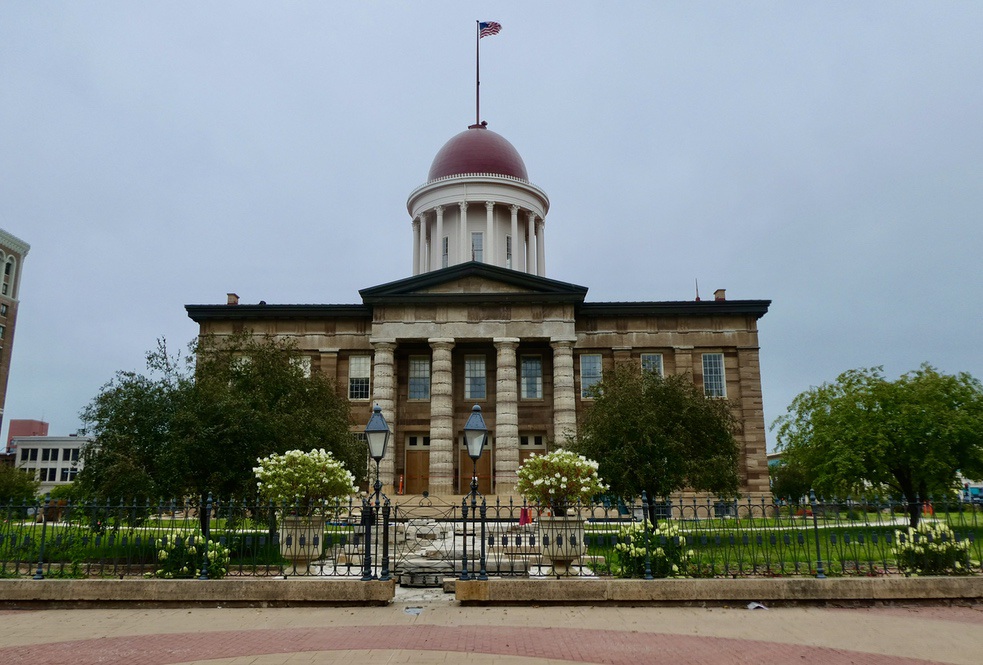
The Old State Capital.

To answer one question from the comments regarding mosquitos.  Since leaving the Upper Peninsula of Michigan, mosquitos have not been an issue.  We were able to sit outside on Mackinac Island with no problem and we were able to enjoy the camping sites on mainland Michigan.


Friday, August 4, 2023

Upper Midwest Tour, Day 26, Aug 4

Today, we drove from one State capital city to the neighboring State capital city (Indianapolis, IN to Springfield, IL).  Not much to say about the views from the interstate highways - mostly flat, mostly corn and soy bean fields.  We arrived by early afternoon and went immediately for a 20-minute guided tour of the Capital building.  Construction started in 1868 and it took 20 years to complete the building.  It has been well-preserved and is currently undergoing major renovations on the north end.

P.S. from yesterday -- this is where we stayed in Indianapolis - Ft. Harrison State Park Inn.

Springfield is Lincoln's City, moving here, becoming a lawyer, practicing law for a couple of decades,  courting and marrying Mary Todd, winning a few terms as a state legislator, and losing several times for the State Senate.


The Capital dome.


The House Chamber.


Frieze around the dome - Lincoln debating Douglas.


A. Lincoln, looking at Stephen Douglas

Stephen Douglas

Original Supreme Court wall paper.

Door handle displaying the state seal.

Then we walked toward the location for the start box for the Capital Volkswalk.  Before arriving there, we dropped into the Lincoln Presidential Library.  It was a great stop and, unlike the modern Presidential libraries,  more of a museum chronicling Abe's life.  The displays were quite good, imaginative, and emotionally moving.  Somewhere there was a statement that more has been written about A. Lincoln than any other person in history, except for Jesus.  Our visit ended with an excellent 17-minute multi-media presentation called "In Lincoln's Eyes" in which an hologrammed artist describes the life story that he could read in Lincoln's face, accompanied by images of the events that made up that life.   


A curious bronze statue on the sidewalk in front of a bank building ----

A little dog with a bone -- no explanation evident.

The old Union Station.

The ever present Lincoln.

Lincoln's life - key dates matched by where he was living.

Continued.

His history of elected offices, up to the Presidency.

A life size diorama showing the development of the Emancipation Proclamation, Lincoln and his Cabinet debating the issue.


After the library, we got the volkswalk route, which was divided into to two loops.  We did most of the Northern loop, which went up to Lincoln's grave, and then returned to the hotel.  

Lincoln's grave


We went for dinner to Loukinens' on 4th, sitting at the bar.  The Guinness (draft) was perfect!  The rest of the meal was good and we had an interesting, short conversation with the hostess, bartender, and one other patron.

Illinois Governor's Mansion.

Capital at dusk.