Thursday, July 28, 2016

Day 26 - Lake Windermere

July 27:  Lake Windermere 'cruise and walk' redo and gourmet dinner at Lucy's on the Plate to celebrate the end of our Lake District adventure.  We took Elaine on the same lake cruise and walk package we had done on Day 7.  We had relatively good weather today and great views of the surrounding fells.

We walked to Waterhead to catch the first of three boats for the day.  We sailed first to Wray's Castle, where the 4.3 mile walk along the northwestern lakeshore begins.  It is an easy stroll, mostly through forests  and along sheep pastures, with a few open spaces for views to the lake.  We reached the ferry landing, checked out a two story folly that the original owners of Belle Isle used for dinner parties.  The building is called Claife Station and provided guests a fine view of the lake. It is still a major tourist destination, although just a skeleton remained of the former structure.  We walked around the ferry landing spit and caught the next passenger ferry.  We rode north, circling around the islands and landing at Bowness.  We walked up the main street for tea.  The tourists were out in force since it is the first full week of summer holidays for British school children.  Our last ride of the day was on a large cruiser back to Waterhead and Ambleside.
Rowboats for rent at Waterside

Our first cruiser - Princess of the Lake

Near the Ferry Landing

Arriving at Bowness
In the morning, I had made reservations for "a last supper" at Lucy's on a Plate, a well-regarded Ambleside restaurant.  The person who answered the phone (Lucy, we learned later) was particularly chatty and want to know if it was a special occasion, where we were from, and what we were doing, etc.  We arrived at the restaurant just before our reservation time and were asked to wait to be seated.  We given printed menus, which made a note of the many people who were dining this night, including "the Thor trio [who] are having an extended European visit and have ventured to us this evening..."  There was a note on the chatty, tightly printed menu stating that "we have some reading glasses that you may borrow if you need."

We were seated and enjoyed two starters - "A Right Nutty Pear" (a salad of warm goat cheese, caramelized pear chunks and walnuts) and "Melon Fantasia" (balls of melon - cantaloupe, galia (like honeydew) and watermelon served with raspberry coulis and sorbet).  Betsy and I both had "Tunisian Tagine" (a Moroccan dish using aromatic spices with vegetables, preserved lemons, apricots and chickpeas with pieces of very tender Lakeland lamb, red pepper cous cous and creme fraiche) and Elaine had "Bobbing Bobotie" (a casserole of minced lamb with aromatic spices, almonds, diced apricots and tomatoes topped with a savory custard, and accompanied by a salad and Mrs. Ball's chutney).   The menu is typed up daily with many creative names for the dishes and detailed descriptions, as I have quoted.

Starters


Everything was delicious and we were too stuffed for desserts, which were equally creative and varied.  There were lots of gluten-free and vegetarian choices throughout.


Wednesday, July 27, 2016

Day 25 - Borrowdale Valley

July 26:  We got up close and personal with sheep today, even more than usual.  As we were heading back to the barn (so to speak) after lunch, we ran into a shepherd walking with a dog and carrying a pair of crooks.  He told us that we were about to encounter a flock of Herdwicks being driven back up to the fells after shearing.  He said not to worry about them but keep moving.  Around the next corner here came the flock, streaming up between stone walls, being pushed on by another shepherd and 6 or 7 border collies who also kept the flock from straying.  We ended up hugging the wall ourselves and just watching.  The steely gray ewes, who knew where they were going, kept moving steadily, although stream crossings slowed them a bit, and the fat black lambs ran to keep up with their mamas.  The ewes were indeed newly shorn with new owners' marks on their backs.  The dogs ran back and forth keeping everything under control, but we could see at least one younger dog who was looking for tips from his seniors.  We watched until the flock cleared the last stone wall and gate up the valley - Phil realized the first guy had the job of opening all the gates before the flock arrived and the shepard in the rear directed the dogs and closed the gates.

 The weather was forecast to be wet but after a few showers in the morning, the rest of the day was pleasantly dry.  We completed a 9-mile walk in the Borrowdale Valley, hitting all the 'thwaite' towns - Stonethwaite, Rosthwaite, Longthwaite, etc.  A 'thwaite' is a Norwegian word for a piece of forest land cleared for agriculture or habitation; a clearing.   To reach our starting point, we drove north from Ambleside to Keswick and then south to the small village of Grange (see photo below for detail).


We walked from Grange south along the River Derwent (flows north to Derwent Water) to the thwaites.

A calm spot on the River Derwent

After seeing slugs forever, I finally photographed one for our record

A typical wildflower field which is mowed, dried and baled for sheep feed during the winter
Our original plan was to go to Seatoller, at the bottom of Honister Pass and then walk back on the western side of the valley on a rougher, steeper trail.  When we met up with a sudden shower, we changed tactics and headed up the eastern valley to Stonethwaite (CtoCers will recognize these names) in search of a waterfall where two valleys meet.  We reached the fall and its scenic little gorge at about 1 pm and ate our picnic lunch on a stoney beach in sunshine!  Behind us, one trail led up the Coast to Coast route to Greenup Edge and Grasmere and the other trail led up the Langstrath Valley that we hiked down a couple of weeks ago.  We had much better weather and much better views than on either of those previous encounters with this area.  Our sheep encounter began as we headed back down the valley after lunch.


We walked through Rosthwaite passing a barn yard with a lot of noise.  When we looked over the fence, we could see sheep shearing in process - two guys manhandling the sheep and cutting off the wooly coats, which seemed to take only a couple of minutes.  We don't know why this one sheep was being held in the blue contraption - she wasn't being sheared and she wasn't very happy.  Across another field, another set of newly sheared sheep were being released back to the open ground.  All these sheep will stay up in the high meadows until late in the fall when they are brought down either to be sold for meat or to be mated for next year's crop (to sustain the flock).


Our walk ended back at Grange with cool drinks from a tea shop, and then Phil drove back to Ambleside.

Tuesday, July 26, 2016

Day 23 - Coniston Country Fair and Day 24 - Stately Homes

July 24:  We ventured off today to the Coniston Country Fair, surprisingly in Coniston in the shadow of Old Man.  The day was full of low clouds and rain so we drove there using the rental car.  We covered the fair grounds pretty quickly - vendor stalls, food stands, a central arena marked out by a rope, several smaller arenas similarly designated, a 'walling' competition area (near an existing wall), and two large tents, one for crafts and one for refreshments.  There was also a small animal enclosure with a cow, 6 sheep, some 10-day-old chicks, and an egg sizing machine that sorts eggs by weight. (We were told that brown eggs, which is what is sold in England by and large, come from brown chickens.)  In contrast to the country fair we saw in Scotland, this one had many fewer farm animals and many more dogs - beagles, hounds, lurchers (a hybrid of greyhound and border collie)but not other sheep dogs.

The Fair from across the water
While it rained, the fair activities were mostly suspended.  We visited the walling competition where several young people were rebuilding a five-foot-high section of dry-laid stone wall.  This is a particularly important skill for the local farmers to have.  The cross section of a good wall is trapezoidal in shape, the two faces fitted together like a jigsaw puzzle, with larger stones at the bottom and connecting stones midway up that join the two faces.  Smaller stones, rubble-like, are placed in the middle between the two faces.

The walling competition site
We spent some time admiring the 3 Herdwick sheep - one tup (male), an ewe and her two lambs.  These are the highland, fell sheep indigenous now to this area but thought to have come originally from Norway.  They are hardy and extremely well adapted to fell grazing.  Their wool is coarse and not of much value, but the interpretative sign said the wool makes very good carpets - tough and long lasting.
Male Herdwick sheep
We then watched some dog judging of fox hounds and beagles.  There were contests for four beagles, matched pairs, and singles.  The larger fox hounds were judged individually.  We watched several red, blue and yellow ribbons awarded but were none the wiser on what makes a winning dog.

Champion beagles
The rain had mostly stopped by then, and the fair started up with children games in the large arena (egg carries, bag races, and even an egg toss).  We bought three varieties of cake in the refreshment tent; it appeared they were homemade by the local folk of the village.  We ate them while watching a demonstration by a falconry organization that had a variety of raptors and owls on display.

Peregrine
One more circuit of the grounds and a check-in at the walling competition was enough for us.  Elaine watched the egg tossing contest while Betsy and I bought the last 2 meat pies from a seller.

We drove over to the other side of Coniston Water to Brantwood, the last home of John Ruskin, so Elaine could tour the house and we could visit the gardens, which we had skipped the other time we were here, due to rain.  The various gardens are laid out on the hillside running down to the lakeside.  I took a lot of photos of the flowers up close and may put a collection of them together when I get home.  Elaine enjoyed the seeing the house and learning about John Ruskin.  We had tea at the cafe before driving home.


July 25:  The weather was a little better today, with less rain but the clouds were still low, obscuring the fell tops.  We visited two stately homes today - Blackwell Arts and Craft House and Sizergh Castle.

We arrived at Blackwell, just south of Bowness, a few minutes before it opened and strolled around the lawns.


There were several quirky, most unlike Beatrix Potter, sculptures (such as a badger as a bag lady) - not sure what the message was.

A "bag lady"
The inside of the house was spectacular.  Every space and all the furnishing reflected the arts and craft design principles.  The house reflected a number of the patterns that make space attractive.  For example, "The heart of every room is the hearth."  There were window seats in every room and benches bordering every fireplace, often placed in an inglenook and including a small window.  Spaces were arranged on different levels and moved the eye from shadow to light.  The woodworking and wood carving were superb.  In contrast to the Ruskin house, we noticed that we were more entranced by the inside of the house than the external views, even though it overlooks Windermere and its fells.


A very nice sideboard
Sizergh, southwest of Kendal, is a castle that has been in the family home of the Stricklands for over 750 years.  While the building and grounds were donated to the National Trust in 1950, the family still has rights to use some of the rooms.  While it was not said, it is a case of not having enough family fortune to maintain the house and gardens.  So why not give it away but retain partial use and let the Trust pay for upkeep.  The original tower (Norman-styled) was built in the 15th century and the rest of the house was added later.  The interiors are large, with dark wood paneling, huge fireplaces with intricately carved "overmantel" pieces, and wide-board, uneven floors.  It is reflective of a true castle, although never used as such.

Sizergh, with the reflecting pool in front and Norman-style tower on left (photo by Elaine)
One wall panel in the "Inlaid Room," considered the finest example of inlaid paneling in England
We took a guided tour of the several gardens.  We started off by viewing the traditional, two-level, great barn, a style designed for the Lakeland hill farms because it took up less room.  We then went to the south garden, with a "hot wall" designed to absorb sunlight to help grow plants needing warmth.  We saw a tall grass garden area which was originally designed to be in the Dutch-style, now just terraced with grasses.  Next was the reflecting pool, which has an infestation of carpet weed,  a surface algae that obscures the reflections.  A volunteer was pulling some of the weed out using a floating rake.  We next visited a limestone rock garden, with fine textures and a nice pallet of colors, the kitchen garden where local vegetables were being grown for the cafe, and finally to the stumpery, a "stump" garden.  The gardeners were still planting the stump garden which contains a hodgepodge of large stumps set on the ground with many ferns and other plants planted among them.  The garden is the 'keeper' or showcase of four rare ferns of England.

The "hot wall"
The new "Stumpery"

The limestone rock garden
We walked down to the nearby Strickland Arms Pub for what we hoped was drinks and snacks.  We did have beer and cider but food service had ended for the afternoon.  We had 'crisps' instead.


Saturday, July 23, 2016

Day 22 - Rydal and Grasmere Loop

July 23:  We broke Elaine in today to the traditional Lake District vacation - a 9.9 mile walk, repeating a route we had done on July 3rd.  We led her to Rydal Water, with a brief stop at Rydal Hall (a country manor, now a retreat center) and Rydal Mount (last home of Wordsworth), on to Grasmere, passing Dove Cottage (Wordsworth's early cottage) and lunch at the Potted Out (panninis and local Collie Wobbles beer for me), and then back along the shores of Grasmere and Rydal Water and along the River Rothay to Ambleside.  I am attaching a variety of photos with some explanations.
A traditional stone bridge originally built for drovers
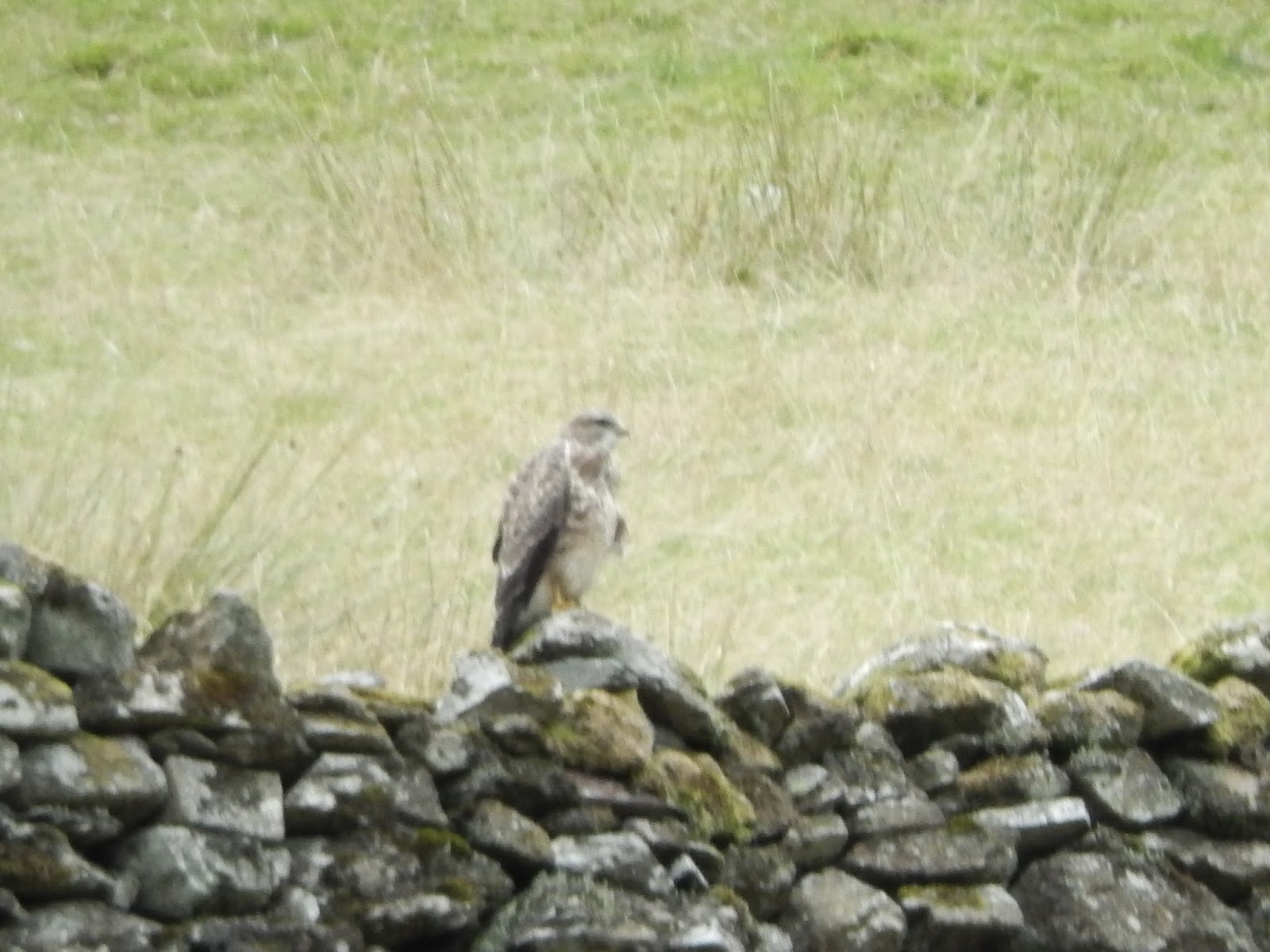
A juvenile buzzard, a common raptor in England; this one had likely been kicked out of the nest and was protesting loudly 
Entering the garden at Rydal Hall
 The following photos are all flowers in the formal garden in front of Rydal Hall.


 Rydal Mount, showing the formerly hidden window - small one on the second floor left.  Windows were taxed and thus covering it over was a "tax reduction" scheme.


From Rydal Mount to Grasmere, we walked the 'coffin route,' the path used to transport coffins from Ambleside to Grasmere for burial since there was no consecrated church ground in Ambleside.  Also, the main road between the two towns was off-limit.


Picturesque sheep taking it easy  
Dove Cottage, Wordsworth's earlier home
The following photo is of one of 200 some-odd Herdwick sheep that were painted by local organizations and distributed around the Lake District, for charity.  Note the headphones instead of horns.  "All I hear is Radio Baa Baa, we will rock ewe."