Saturday, May 28, 2016

West Highland Way Day 1 - Milngavie to Drymen

May 27:  This was our first official day on the Way, that is the West Highland Way.
The Starting Point
We covered 13+ plus miles from the hotel, but only 12 miles from the start of the official route to Drymen.  It was a typical hiking day, with cloudy weather, moderate temperatures great for walking (i.e., no sweating), no bugs and pretty level.  The scenery was great with views of some small "bens" (mountains), rolling pasture and farmland, a few tree plantations, small lochs, and first view of Loch Lomond.

"The Way"
We started just after 9:00 am and reach our destination (Drymen at the Braeside B&B) just about 3:00 pm.  We had a lunch break at Beech Tree restaurant, at about mile 7.  The owners seized the opportunity to serve hikers on the Way with a welcoming attitude and warm hospitality - they provided food, drink, and a welcome toilet stop.  Betsy and I had tea, crisps and leftover bagel with cheese for lunch.
Lunch spot
Notable sightings included the WHW Trail Angels (a charity dedicated to preserving the Way; they had a "wildcat" and a wolf pup in attendance and were soliciting donations), numerous groups of hikers and a few stately homes off in the distance.
Wolf pup
Blue bells

Spring flowers along the roadside
The Braeside B&B was very welcoming.  They had assigned rooms to us all and even carried our luggage to the rooms.  They made reservations for dinner for us and directed us to one of the oldest pubs in the area (across the street).

Our room at the Braeside B&B, very comfy

The best beers yet - national lager on the left, local ale on the right
Beers were excellent - we all found that the local ale brewed by Belhaven ('Twisted Thistle IPA') to be particularly good.  Dinner at the Drymen Inn was also fun sitting in a conservatory-type room off the front of the building.  After dinner, I strolled around the village, seeing a lawn bowling match going on and another view to the north of Loch Lomond and Conic Hill (points on the Way that we will see up close tomorrow.

Thursday, May 26, 2016

Day 0 Glasgow to Milngavie

May 26:  We are on our way even though we don't get on "The Way" until tomorrow.  After a nice buffet breakfast in the hotel, the gang gathered just after 9 am and started walking - in full hiking regalia today, with boots and loaded packs.

Way marker through Glasgow
Waypoint 001 - Park Circus in Glasgow
We walked northwest through town to the Kelvin Way and followed the Kelvin river through attractive parkland.  There were a few people out walking dogs or jogging but we had the trail mostly to ourselves.  We crossed under a number of impressive stone bridges and passed a few low weirs.

One of the many bridges over the River Kelvin
After an hour or so, we seemed to pass suddenly into the countryside, with horses, deer, and even a fox on the other side of a meadow.  The track got more primitive, so we were glad of the boots.  At one point we saw a swan cruising in the river - not a big deal in this country - but a pair of guys doing trail maintenance told us it was a rare and special whooper swan, who should have been on his way north by now.

After climbing through and over a number of stiles, we spotted the Tickled Trout Pub in the near distance and decided we had earned a lunch break.  Some of the group went inside for a hot meal and the rest of us sat outside to have a picnic with hot drinks.  The weather threatened but never quite turned to rain.
Lunch Stop
In another hour we reached our hotel in Milngavie (pronounced, and historically spelled, as Millguy - the English apparently fancied up the spelling).  We checked in but learned that our luggage had not arrived - nor even been picked up in Glasgow.  When Phil called, he was told that Absolute Escapes had not arranged for baggage transport for today, even though they booked us in to the Glasgow hotel and gave us detailed walking instructions for today.  The transport company agreed to go retrieve our bags, since it is less than a dozen miles between the two hotels.

(3:45 pm.) The bags just arrived! Yippee.

Pastoral View

As a side note, our support company booked us in to Premier Inns in Glasgow, Milngavie, and again in Fort Williams.  It is a relatively recent hotelier that we first encountered 3 years ago at Gatwick airport.  The inns are modern, clean, efficient, and very well designed.  They follow a cookie-cutter approach so every room looks just about like the next one but after a few days fighting with unpredictable plumbing at other places, you get to appreciate showers with decent pressure and hot water that comes promptly and lasts as long as  you need it.


Wednesday, May 25, 2016

Transition Days

May 24-25:  Yesterday was a day spent washing clothes and thinking about moving to another hotel in Glasgow and starting the West Highland Way trek and the accommodations provided by our walk supporter Absolute Escapes.  I spent some time updating the travel blog for the prior 2 days and giving some advice Mark regarding the use of the GPS app we all use to track our walks.

Mid-afternoon, Betsy, Kathy, Mark and I walked from our penthouse apartment along the River Clyde to the Glasgow Transportation Museum.  We passed a number of newish residential developments, a convention center and adjoining hotels, an odd shaped building that is known as 'the armadillo,' and Clydeport, the area where ship building was done up through WWII.  The docks are and surrounding riversides are now derelict, with most structures removed.  This is the site where a great many famous ships were built, including the Lusitania, Queen Elizabeth I, Queen Mary, and Queen Elizabeth II (QE2).

After 'touching the Transportation Museum' we hustled back the 2.5 miles to the apartment to prepare dinner for our entire walking group.  Our last 2 members, Carolyn and Tom, arrived in Glasgow Sunday and though they were staying at a different location, they came for dinner.  We had a great meal of pasta with bolognese sauce and various toppings (smoked salmon, shrimp and meatballs), salad and wine.

Dinner for ten in the penthouse
Today, we packed our stuff and after a leisurely breakfast, trying to eat up most of the leftover food in the apartment, we rolled our luggage up the main pedestrian mall to the Premier Inn, about 0.8 miles.  It was too early to check in so we left our luggage and all walked to the Transportation Museum.

Transportation Museum
We spent an hour and half touring the museum which has displays on all manner of land vehicles and ocean ships, and visiting a tall ship "parked" outside.  The displays were extensive and quite well done, with many interactive ones.  There was the "oldest bicycle," and many others, motorcycles, cars of all ages and descriptions, many models of large and small ships, tram cars, steam locomotives, RVs, and other types of mechanical conveyances, mostly in prime condition.  For shear elegance, it's hard to beat one of the grand touring cars from the 20s and 30s.

The oldest bicycle, circa 1840ish
Just a few cars, etc. on display
Steering the tall ship
We left the museum and headed out along the Kelvin Way, covering 1.5 miles of the official route that we will walk tomorrow.  This walkway starts at the river, follows the narrow River Kelvin, and extends 10 miles to Milngavie, (pronounced 'mull-guy') which is the official start point for the West Highland Way (WHW).  After lunch, we returned to the hotel, got checked in, and adjusted our packing for the start of the trek.  From here until we reach Fort William, our luggage will be transferred ahead by a service.

We went out for drinks at The Horseshoe, a famous local pub on a back street, known for its appeal to the locals.  We squeezed in and enjoyed a noisy happy hour.  Carolyn and Tom went off for an intimate dinner while Kathy and Mark retired to the hotel.  The rest of us went to dinner at "the best Italian restaurant in the UK" (2011) - Piccolo Mondo.  We each had 'two-course set menu' dinner and shared a fabulous bottle of prosecco.   The food was quite good, and everyone was impressed by the classy 'toilets.'


Tuesday, May 24, 2016

Glasgow, again and Edinburgh

May 22-23:  Sunday was mostly a lazy day in Glasgow with outings to a unique 'kinetic' display gallery, followed by a look at the Glasgow School of Art (GSA).  However, the first trip out was to an electronics store for a camera battery charger.  I was using the charger built into the camera, but it was less than reliable, so I purchased a dedicated 'universal' charger.  The contact pins are slid sideways to line up with the battery terminals (which allows any battery size to be charged) and it even gives the percent of charge on the battery.  This is a very nice addition to my growing collection of electronic support equipment, which is quite an heavy bag.  On the way to the store, we walked next to a large women-only charity run (for cancer).

Race along the pedestrian mall
Our next stop was the Sharmanka Kinetic Theatre (sharmanka is Russian for hurdy-gurdy).  we walked around the displays consisting of sculptures or automatons made from found objects, scrap and hand carved wooden figures and the like, crafted by a Russian immigrant to Scotland, Eduard Bersudsky.  He worked for many years for the Glasgow Parks Bureau carving animals from fallen trees in parklands.  "Set to haunting music, the figures perform humorous and tragic stories of the human spirit."  For a modest price, we watched a 30-minute show of one collection of sculptures.  It was fun and quirky.

The collection of sculptures we watched
Biking to the Moon
We next returned to Drygate which has a Sunday market on the first and third Sunday's of each month.  After arriving and figuring out that the 22nd was the fourth Sunday of the month, we sat and had drinks on the terrace of Drygate Brewpub, enjoying the sunshine.

As Varis says - 'we are hydrating' at Drygate
Next door to Drygate, there is a huge Tennent distillery/brewery, with the following pronouncement:

Tennent's
After the break, we walked across town to the Glasgow School of Art, which has a main building designed by Charles Rennie Mackintosh.  The guide books say it is his "greatest building" and the library, "designed as an addition in 1907, is a masterpiece."  It was damaged in 2014 by a fire that started in the library, and building access is now restricted.  We arrived well after tour times and within 20 minutes of closing of the information center.  We sat across the street and studied the exterior, half wrapped in scaffolding for repairs.  We had an early, tasty dinner at the nearby Red Onion before walking back to the penthouse.

The entry to Mackintosh's GSA Building
On Monday, Leslie, Dennis, Kathy, Mark, Betsy and I rode the bus to Edinburgh, which took an hour and 15 minutes.  We were dropped off below the castle.

Edinburgh Castle from Princess Street
We walked up to the Castle, which is built on a volcano, known as Castle Rock, and according to our introductory tour guide, has been a site of habitation since BC, though the first castle walls were not erected until the 11th century.  There have been many destructions and reconstructions of the years.  On entry, we saw the 'changing of the guard' band march out onto the Tattoo area - they are already constructing the temporary stands for the annual Tattoo performances that take place in July.

Changing of the Guard Band
The points of interest inside the castle are numerous and varied, ranging from the oldest structure (St. Margaret's Chapel), multiple Gates, two approaches to the central heart of the castle, military barracks, the Great Hall, the Scottish National War Memorial, Scottish Crown Jewels including the "Stone of Destiny" (what all British monarchs sit upon during coronations), prisons, Mons Meg (a medieval siege-busting cannon that weighs 15 tons and shoots a 300 pound ball - not very accurately), and the one o'clock gun.  We had pre-purchased tickets and did not have to wait in the queue to get inside.  

We followed a tour guide around the outside areas and listened to his introduction to the castle.  Just as he was concluding, there was a changing of the posted guard, which was much abbreviated compared to what happens at Windsor Castle or Buckingham Palace.
Changing of the Guard at the National War Memorial
We then toured around on our own.  

Stained Glass to William Wallace and Robert, the Bruce
Ceiling of the Great Hall
We saw the crown jewels and Scottish royal insignia, and learned about how they were protected from the English and later discovered buried in a church.  Photographs were not allowed of them, nor inside the War Memorial, which is quite impressive.  It is built like a church with chapels to various regiments, including a section for women and even a small commemoration to the animals that have "served."  The guide told us the story about an ensign who captured a French Eagle, a standard or imperial banner, at the Battle of Waterloo.  It is on display in the Royal Scots Dragoon Guards museum.
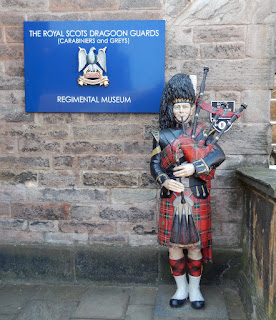
Museum to the Royal Scots Dragoon Guards
The captured "French Eagle"
We met up after an hour on our own and walked  as a group down the Royal Mile.

the meet-up
We stopped for lunch at the St. Giles Cafe, partway down the Royal Mile.  After lunch, we completed the stroll downhill to Holyrood Palace, a royal residence that is currently occupied by a high commissioner of the Anglican Church of Scotland, in town to attend the General Assembly meeting this week.  The guards posted at the castle and the Palace were in place because of the commissioner's (Lord Hope) residency.

Holyrood Palace
Since the weather was splendid, we then hiked up Arthur's Seat, another volcano that overlooks the city.  We took a circuitous route to the 750-foot summit, giving us great views over the city and Firth of Forth to the north.
Proof of something
View from the summit of Arthur's Seat, 254 meters
Looking back to the summit
More proof
We moseyed back toward 'New Town' by way of St. Andrew's House, the seat of Scottish Government, and couple of grand hotels.  We walked the length of George St. that runs through the center of New Town, a section of the city built in the 18th century of Georgian design, like Bath,  England.  We stopped at the Rose and Crown for drinks - inertia captured us and we stayed for dinner.  We caught a bus back to Glasgow, arriving around 8 pm.


Sunday, May 22, 2016

Sightseeing in Glasgow

May 20-21:  We and the rest of the gang have been walking around Glasgow for two days seeing the top 'tourist' sites - Buchanan St., George Square, City Hall, Glasgow Cathedral, Necropolis, Doulton Fountain, People's Hall, along the Clyde, Macintosh House at the University of Glasgow, the Hunterian and Kelvingrove Museums, and the Botanic Garden.

Friday, we began developing the rhythms for 8 people living in a single apartment with two showers. There are 3 bedrooms on the upper floor, while Jan & Ron have been using the fold-down sofa in the main floor sitting room.  The main floor also has a large living room, a dining room with room for 8 and a spacious kitchen.  There are also terraces on both floors with views of the River Clyde and south.  We can sit outside if/when the weather gets warmer and dryer.

After breakfast we walked up Buchanan Street to the Visitor Information Centre.  This street has been restricted to pedestrians and contains most of the normal big city shops, along with a variety of local specialities.  We checked at the information center for private tours or guides for our group, but the staff couldn't suggest any.  After getting a few brochures and maps, we stopped for coffee to go at Cafe Nero (British 'Starbucks') and walked to the east side of the city center.  We went through George Square with its statues of famous Scotsmen such as James Watt and Robert Burns, decorated with pigeon droppings.
James Watt, inventor/improver of the steam engine
Adjoining the square was City Hall, which has such a nice ornate interior that there are regular tours (we skipped the tour after hearing the introduction and taking many photos). We moved back outside and uphill toward the Cathedral.
Inside City Hall
The exteriors of the most of the buildings in the city are built of red sandstone with lots of ornamentation, a very distinctive look.  They range from 5 to 8 stories tall; surprisingly, there seem to be no modern skyscrapers (or I have missed seeing them).

Typical city building

The Cathedral is quite grand, sitting high in 15th century Gothic splendor.  The interior is completely accessible and we walked all around.  The front half, in front of the choir screen, was bare of pews. The back or eastern half had two levels with a standard "pewed" worship area over the catacombs.  There were small side chapels and a robing room attached at the ends.  In the catacombs was the tomb of St. Mungo, patron saint of Glasgow.  Betsy was tickled by the Sacristy with 'walking' mottos set in the floor:  "He that walketh upright walkest surely."  "Let us run with patience the path that is set before us."

The Cathedral from the Necropolis
Roof of the Cathedral
Glasgow Cathedral

From there, we walked further uphill to the Necropolis where the rich folk of Glasgow got planted in the 19th century.  The monuments were tall, fairly plain, but with great views.

Necropolis
We then walked downhill to a brewery, Drygate,  that offered excellent food, including disassembled sandwiches.  The chefs arranged all the tasty, fresh ingredients on a serving  board, and you built your own sandwich.  After lunch, we walked through People's Park, a big green space along the River Clyde.  

Inside the People's Palace
Doulton Fountain
There was a tall terra cotta fountain commemorating the British empire and the late 19th century People's Palace, which includes a glasshouse and a museum about Glasgow social history from the prosperous19th century to the crowded, depressing tenements of the first half of the 20th century.  Among other exhibits, there was a "steamie" where women went to wash clothes and socialize.  Dinner that night was at a very good restaurant called Gondolfi-Fish.

Saturday we walked into the northwest area of the city and visited some splendid museums.  We went past the shopping district and then along some gated parks into the public park of Kelvingrove with flower gardens, sports fields and play areas.  The  whole area is named after Lord Kelvin, one of the great thinkers of the Scottish Industrial Revolution.  The University of Glasgow campus sits at the top of the hill.  The main buildings include a great neo-Gothic complex with two quadrangles, towers, and a tall chapel.  As we went by, Glaswegians in kilts and party dresses were walking to a wedding in the chapel.

We went into the Hunterian Art Gallery which was also the access point for the
Rennie Mackintosh House.  We walked through the eclectic art collection of the museum while waiting to tour the house.  Mackintosh and his wife were noted designers of the early 20th century who specialized in art deco style.  The house they lived in was demolished years ago, but their furnishings were stored away until the university constructed a "surrogate" building that matched the original layout.  We had a 30 minute guided tour and were thrilled with the grace and elegance and brightness of the decor.

Macintosh House (reconstructed with actual furnishings)

We then crossed in the University quadrangle, watched the wedding party being photographed, and explored the Hunterian Museum.  This museum contains the wide-ranging collection of a former student at the University who was interested in everything in the known world, from fossils to medical devices to engineering technology.  There were exhibits describing the accomplishments of Lord Kelvin who determined the absolute temperature scale and various other scientific principles and Lord Lister who pioneered sanitary practices in medicine.

East Quad of Glasgow University
By this point, the group was feeling peckish, so we walked downhill to Mother's Indian Cafe and had a wonderful, relaxed lunch of Indian food.  We then crossed the street into the Kelvingrove Art Gallery and Museum, another great neo-Gothic building with widely varied exhibits - more Mackintosh, Scottish animals (including midges), and Scottish paintings.  We had only a little time before the museum closed at 5 pm so didn't cover the full gamut.

Kelvingrove Museum
Kathy encouraged us to do one more exploration, uphill again, to the Botanic Garden.  It was a pretty public space with a series of great glasshouses, which are always fun.  There were rooms of desert plants, ferns, tropical trees, orchids, begonias and food plants from around the world.  (Surprising fact - vanilla comes from an orchid.)
Botanic Garden Glasshouse
By the time we left the garden, our energies had totally flagged so we caught the local underground back to the city center.  Since we had eaten a late lunch, we opted for a DIY chef salad supper back in the flat.  As we ate, we compared impressions about the various museums and our favorite exhibits.  Several of the guys liked a wonderful Rubens portrait of an old man with a flowing beard, at the Hunterian Art Gallery.  Betsy liked the Whistler paintings of tall elegant women, also at the Hunterian, and the displays of how birds construct their nests, at the Hunterian Museum.